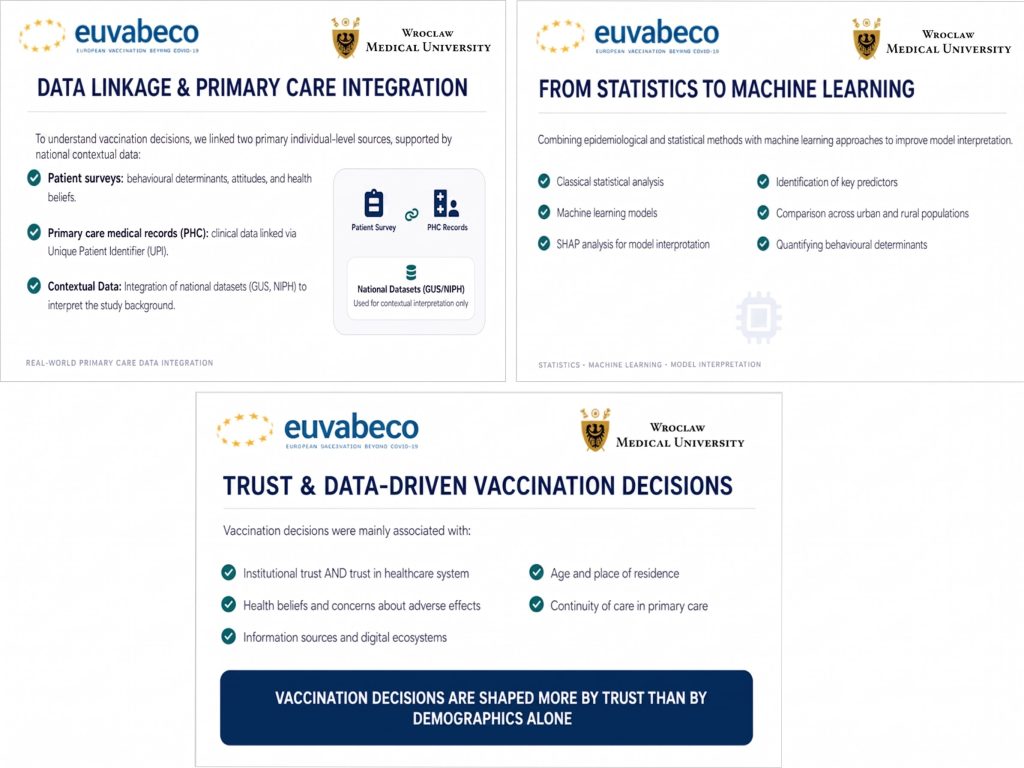
How the Wrocław Medical University team is combining surveys, clinical records and machine learning to describe drivers of vaccination in three primary healthcare centres in Poland.
As part of the EUVABECO (European Vaccination Beyond COVID-19) project, researchers at Wrocław Medical University in Poland have been linking data across two sources to optimise vaccination campaigns. A multidimensional study was conducted across primary care settings, combining information from patient surveys and clinical records from participating centres, and contextualising findings using publicly available national population-level statistics.
Data Linkage: Moving beyond isolated datasets
The study enabled individual-level linkage between two sources within participating primary care centres:
- patient survey responses
- corresponding medical record data (for consenting participants)
Publicly available national population-level statistics were used for contextual and comparative interpretation.
Data were collected across three primary care settings – urban, small-town, and rural – enabling analysis of vaccination drivers both between and within different setting types.
Analytical approach: From Statistics to Machine Learning
The analytical framework combined classical epidemiological and statistical methods with machine learning models, chosen for their ability to capture complex, non-linear relationships that standard analysis can miss. To ensure findings remained transparent and interpretable, the team also applied SHAP-based analysis (SHapley Additive exPlanations).
Where many machine learning models function as a “black box” – producing predictions without explaining why – SHAP helps interpret outputs by estimating the contribution of each feature to a given prediction. For each individual case, it quantifies how much different factors (such as a patient’s trust in health institutions, their age, or their sources of health
information) push the prediction in one direction or another. This allows researchers to look beyond model outputs and examine which variables were most influential and how they were ranked in terms of their effect on vaccination decisions.
Key Insights: What drives vaccination decision-making
The analysis found that vaccination decisions were primarily shaped by three clusters of factors:
1. Institutional trust – in the healthcare system
2. Health beliefs – particularly concerns about adverse effects and long-term safety
3. Information ecosystems – with unvaccinated individuals tending to rely more heavily on
informal and digital sources
Trust-related variables proved more informative than demographic factors alone, though age and place of residence/distance to a primary healthcare centre remained relevant – a finding with implications for how vaccination communication and outreach could be designed.
Methodological Contribution: A Framework for Data Linkage
using Primary Care data
A central element of this work was a feasibility assessment of data linkage using data routinely collected in primary care. The team navigated key operational challenges including patient consent processes for linking survey and medical record data, comparing locally collected results to datasets from multiple institutions, and working within the practical demands of everyday clinical workflows.
What’s Next: Publications in Preparation
Wrocław Medical University is preparing a series of scientific publications covering behavioural determinants of vaccination and epidemiological patterns across the study populations. Together, these outputs are intended to support evidence-informed decision-making at the local level – contributing to the broader EUVABECO mission of strengthening vaccination systems across Europe.